Discover ‘The Sovereign Standard’ at PPMA Show...
We are returning to PPMA Show in September, where the leading UK name in labelling and sleeving equipment will demonstrate...
Posted on 4 August 2026 by Thomas Glendinning
Tamper-proof labelling gives businesses a way to protect products and prove they have not been opened.
A tamper-proof label shows a customer whether a product is still sealed. Many labels use a tab that connects the lid to the body of the container. Some use text or a pattern that breaks apart if the seal is removed.
The right adhesive makes this work. A pressure-sensitive adhesive bonds so firmly that the label cannot come off in one piece. The customer must tear the label to open the product. This gives a clear, visible sign that the seal has never been broken.
Tamper-proof labelling offers strong value for money. It does not need a purpose built container with extra parts. A brand can add the tamper function to an existing label using a tab or a line of perforation.
This makes the approach versatile. Manufacturers can apply tamper-proof labels to many packages. They work across different materials, shapes and surfaces. This flexibility keeps costs down while keeping products secure.
Food and medical products rely on tamper-proof labels most often. Any product that needs sanitary conditions benefits from this protection.
Many regulated medical and pharmaceutical products are legally required to incorporate tamper‑evident features; requirements vary by product type and jurisdiction.
Food products gain a different advantage, as clean and sealed packaging builds consumer trust and makes a product more appealing on the shelf.
The market for tamper-proof and tamper evident labelling continues to grow, with several factors shaping demand:
Online retail now moves huge volumes of packaged goods through warehouses, sorting hubs and couriers. Brands need tamper evident solutions that survive this handling and still show any interference by the time a parcel reaches a customer’s door.
In the EU/EEA, most prescription medicines must carry both an anti‑tampering device and a unique identifier under the Falsified Medicines Directive. In the UK, requirements differ; packs for Northern Ireland follow EU rules, while Great Britain has diverged, though MHRA guidance still supports tamper‑evident measures across the pharmaceutical sector.
Producers selling into the EU must also comply with the Packaging and Packaging Waste Regulation (PPWR), which drives more sustainable packaging design and requires tamper‑evident features to be compatible with recyclability and circularity goals.
RFID and NFC chips now sit inside tamper evident labels for premium goods such as cosmetics and pharmaceuticals. These labels let a brand track a product through its supply chain and let a customer verify authenticity with a phone. Analysts expect this convergence of security and digital verification to keep expanding through the rest of the decade.
Brand owners want tamper evidence without harming recyclability. Suppliers are developing void labels and adhesives that work on recycled substrates. Some manufacturers are trialling biodegradable security films and reactive inks that change colour when a seal is broken.
Together, these trends confirm what many packaging teams already sense. Tamper-proof labelling has moved from a simple safety feature to a wider tool for brand protection, supply chain visibility, and sustainability.
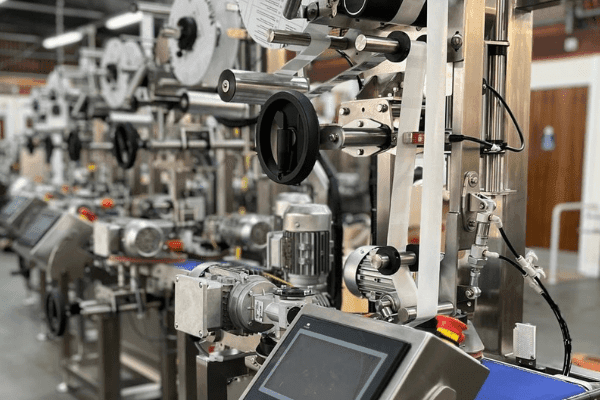
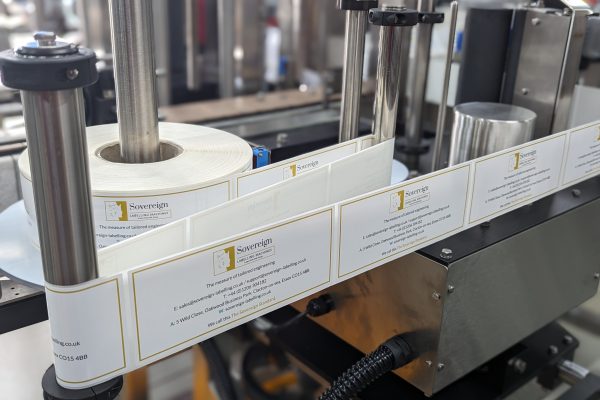
We tailor labelling solutions to suit your products, your line speed and your packaging materials and our modular labelling machines apply tamper-proof labels with precision. The application becomes a natural part of an existing packing line rather than a separate process.
Frequently Asked Questions
Tamper-proof labelling aims to stop tampering from happening at all. Tamper evident labelling focuses on showing clear evidence if tampering has occurred. In practice, most commercial labels do both jobs at once.
Yes, for many medical and pharmaceutical products. Prescription medicines must carry an anti-tampering device under the Human Medicines Regulations. Food products are not always required by law to carry tamper-proof labels, but many manufacturers use them to build consumer trust.
Yes. Most tamper-proof functions can be built into a standard label using a tab or a line of perforation. This means manufacturers rarely need to invest in a new container design.
Yes. Sovereign’s modular labelling machines apply tamper-proof labels automatically as part of a standard packing process, at speed and with consistent accuracy.


Managing Director of a business that is passionate about building top quality machinery for a range of industries- machines that are designed to meet the requirements of each particular business we serve & machines that exceed the expectations of those who purchase & operate them.
As an experienced Project & Mechanical Design Engineer, skilled in AutoCAD Mechanical, Solidworks, Engineering principles, Strategic Planning, and Project Management, with a Mechanical Engineering based qualification from University of South Wales, it is my privilege to lead SOVEREIGN, to align the strategic goals within the group of companies & continue to uphold & maintain a well-respected brand of machines across the UK, Ireland & across the globe.
Learn MoreInterested in Sovereign Labelling adding its trusted and proven engineering expertise to your machine labelling requirements?
Get in touch today and we will be back to you quickly to discuss how our meticulous attention to detail can bring engineering innovation to your business.

Sovereign is a 30 year old company! Some of our employees been in the labelling industry for over 25 years.

Fully designed & manufactured in the UK for the last 30 years.

Robust build quality. All of our applicators are mounted on stainless steel frames, which are hygienic, long-lasting & robust.

Flexible, bespoke design capabilities, we don’t build machines to stock but rather design & build machines to suit each customer's requirements i.e. footprint, budget, product type, throughput, etc.

Extremely low cost of ownership, the components we use to build our machines are of the highest standard & quality, therefore offering machines that require very little maintenance spend over its lifetime.

We recommend when you should service your machine, based on running times & usage, we tailor a spares package to suit each individual machine so customers are only buying exactly what we recommend as critical spares.

All machines are PLC controlled, we design each program ourselves, tailored to each machine, with easy to navigate through settings/control via an HMI, which comes standard with each machine.

We are constantly looking at ways to improve the efficiency of our machines, to reduce setup times and make it simple to use for the operators.