Discover ‘The Sovereign Standard’ at PPMA Show...
We are returning to PPMA Show in September, where the leading UK name in labelling and sleeving equipment will demonstrate...
Posted on 4 September 2026 by Sovereign Labelling Machines
Labelling sits at the heart of every production line, whether for food, beverage, dairy, cosmetics, pharmaceuticals, automotive fluids, or dozens of other markets. It builds brand identity, carries compliance data, and is often the last thing standing between a finished product and the consumer’s hand.
Yet many factories still plan lines around filling and packing, treating labelling as an afterthought. The result: equipment ill-suited to current or future demands, more line errors, and a growing list of slowdowns, breakdowns, and bottlenecks.
That gap is becoming harder to ignore. Through 2026 and into 2027, a mix of standards-led transitions, regulatory requirements, and retailer expectations is converging on the same piece of equipment: the label.
GS1’s Sunrise 2027 barcode initiative, the FDA’s food traceability rule (FSMA Rule 204), and the pharmaceutical serialisation requirements of the Drug Supply Chain Security Act (DSCSA) are each pushing brands and their manufacturing partners toward more data-rich, more accurate, and more frequently changed labels. At the same time, sustainability pressure is driving a shift toward mono-material and linerless constructions that behave differently on the line, and shorter runs with unique artwork are placing new demands on variable data printing (VDP).
None of these trends exist in isolation. Traceability, sustainability, and SKU complexity are converging on factory floors right now, and labelling is shifting from a downstream task to a core constraint for production lines. Rather than a burden, this convergence is an opportunity for brands and co-packers that treat labelling as integral to line design and turn a potential bottleneck into a measurable competitive advantage.
GS1’s Sunrise 2027 is an industry-led initiative aimed at getting retail point-of-sale systems worldwide ready to read and process GS1-compliant 2D barcodes, such as DataMatrix and QR codes carrying a GS1 Digital Link, alongside existing linear barcodes like UPC and EAN by the end of 2027.
While there is no legal penalty for missing the date and no fixed date has been set for retiring linear barcodes; GS1’s own guidance anticipates that 1D and 2D symbols will coexist for as long as retailers need them to.
For many brands, especially during a transition where retailer point-of-sale readiness varies widely, the practical route will be dual marking, printing both a linear barcode and a 2D code, and encoding the same GTIN on the same label or pack. This is where the operational load lands.
Dual marking means two codes must be positioned correctly on every pack, with tighter placement, quiet-zone, and registration requirements. Because 2D codes can also carry variable data such as batch, lot, and expiry information depending on the chosen syntax and connected systems, the application process has to keep pace with increasingly data-rich printing and coding workflows.
In the US, Section 204 of the Food Safety Modernization Act, the FDA’s Food Traceability Rule, is fundamentally a data and recordkeeping requirement. It requires businesses handling foods on the Food Traceability List to capture, maintain, and share standardised key data elements at defined critical tracking events across the supply chain.
The original compliance date was 20 January, 2026. The FDA proposed a 30-month extension in August 2025, and Congress has since directed the FDA not to enforce the rule before 20 July, 2028.
The later date doesn’t remove the underlying pressure, rather extends the planning window. Covered businesses still need systems for capturing, maintaining, and sharing traceability lot code information. Many operations will translate that requirement into more disciplined case, logistics, or pack-level coding, built around a GTIN and batch/lot number, even though the rule itself is a data and recordkeeping mandate rather than a consumer-label mandate.
For labelling lines, that still means readable, verifiable, and durable barcodes that hold up under real production speeds, not just in testing.
Brands and co-packers with a longer runway to July 2028 have time to build this into new line specifications rather than retrofitting under time pressure but only if they start planning now rather than waiting for the deadline to move again.
Another development of note in the US is the Drug Supply Chain Security Act’s (DSCSA) enhanced drug distribution security requirements followed a stabilisation period that ended in late 2024, after which the FDA began enforcing enhanced package-level traceability requirements for manufacturers, repackagers, and wholesale distributors, subject to role-specific compliance policies and exemptions. Small dispensers currently have a further exemption from certain requirements through to 27 November 2027, giving the FDA time to complete its assessment of that segment before finalising next steps.
For pharmaceutical manufacturers and their contract packing partners, this means covered prescription drug packages must carry a compliant product identifier, usually a standardised GTIN/NDC, expiry, lot, and serial number applied accurately and verified in real time. Many supply chains also rely on case and pallet aggregation and EPCIS-based electronic data exchange to meet trading-partner expectations, even where these are implementation practices rather than universal statutory line items.
Unlike Sunrise 2027 or FSMA 204, DSCSA enforcement is already substantially underway for most of the supply chain. This is an operational reality today and leaves very little room for labelling errors.
Brands face growing pressure, from regulation such as the EU’s Packaging and Packaging Waste Regulation (PPWR), from retailer scorecards, and from consumer expectations, to move away from traditional multi-layer, multi-material label constructions.
This is growing the use of more challenging label constructions, such as mono‑material or tinner/stiffer facestocks and a new generation of adhesives.
The catch is that these materials might not behave like conventional pressure-sensitive labelstock on a labelling line. Different facestock stiffness, adhesive tack, and silicone topcoat behaviour affect unwind tension and dispensing.
Lines calibrated for standard liner-backed labels often need fresh tension and pressure settings, and perhaps even new tooling, to handle mono-material and thinner/stiffer formats without rejects, poor placement, or adhesion failures.
Without making the required adjustments, sustainability gains on paper can quickly turn into quality losses on the factory floor if the labelling equipment isn’t set up for the new substrate.
The regulatory and material trends above land differently depending on where a business sits in the supply chain.
Brands carry the compliance and reputational risk. They own the artwork, the barcode strategy, and the relationship with regulators and retailers. This means they set the specification that everyone downstream has to hit. Their core challenges are therefore coordinating portfolio-wide changeovers, alongside balancing sustainability commitments against line performance and owning product and data integrity, end-to-end.
Contract packers (co-packers) in contrast carry the execution risk, often for several brands at the same time and running on the same labelling line. Their core challenges include changeover frequency and speed, equipment flexibility and the verification and audit trail.
Added to the above, skilled labour is harder to find across the packaging sector, while SKU counts keep rising. This combination makes manual labelling and manual verification increasingly untenable.
This is why fully automated lines, from infeed through labelling and sleeving, to dispatch, are in high demand. Pairing servo-driven applicators and reliable conveying with inline coding and marking, integrated vision inspection, and item-level ejection keeps faulty products out of the outbound stream and protects both compliance and brand reputation.
For co-packers running mixed-client lines, this kind of error-proofing is the only practical way to manage frequent changeovers, multiple substrates, and multiple compliance regimes without a corresponding jump in headcount.
Reliable, adaptable labelling is becoming a strategic requirement, not a line-side afterthought, as the supply chain manages shorter runs, changing substrates, tighter traceability rules, and mounting pressure to cut waste.
The most effective response is to treat labelling as an integral part of production line design from the outset. Careful integration, repeatable changeovers, inspection, and verification help brands and co-packers alike protect compliance while maintaining throughput and product quality.
Retrofitting older equipment remains an option, but it typically demands more planning and a higher long-term investment than building flexibility in from the beginning of a labelling project.
The stronger path is to work with an equipment partner such as Sovereign Labelling Machines that understands the specific pressures of each side of the supply chain: the brand’s compliance and portfolio-wide coordination challenges; and the co-packer’s changeover speed and multi-client verification needs.
Those who plan ahead will turn labelling from a potential bottleneck into a measurable production advantage; those that continue to treat it as an afterthought will find the next few years considerably harder.
Contact us today to discuss how tailored labelling and sleeving solutions delivered according to The Sovereign Standard can help you remain competitive, ensure compliance, and prepare for the future.
Interested in Sovereign Labelling adding its trusted and proven engineering expertise to your machine labelling requirements?
Get in touch today and we will be back to you quickly to discuss how our meticulous attention to detail can bring engineering innovation to your business.

Sovereign is a 30 year old company! Some of our employees been in the labelling industry for over 25 years.

Fully designed & manufactured in the UK for the last 30 years.

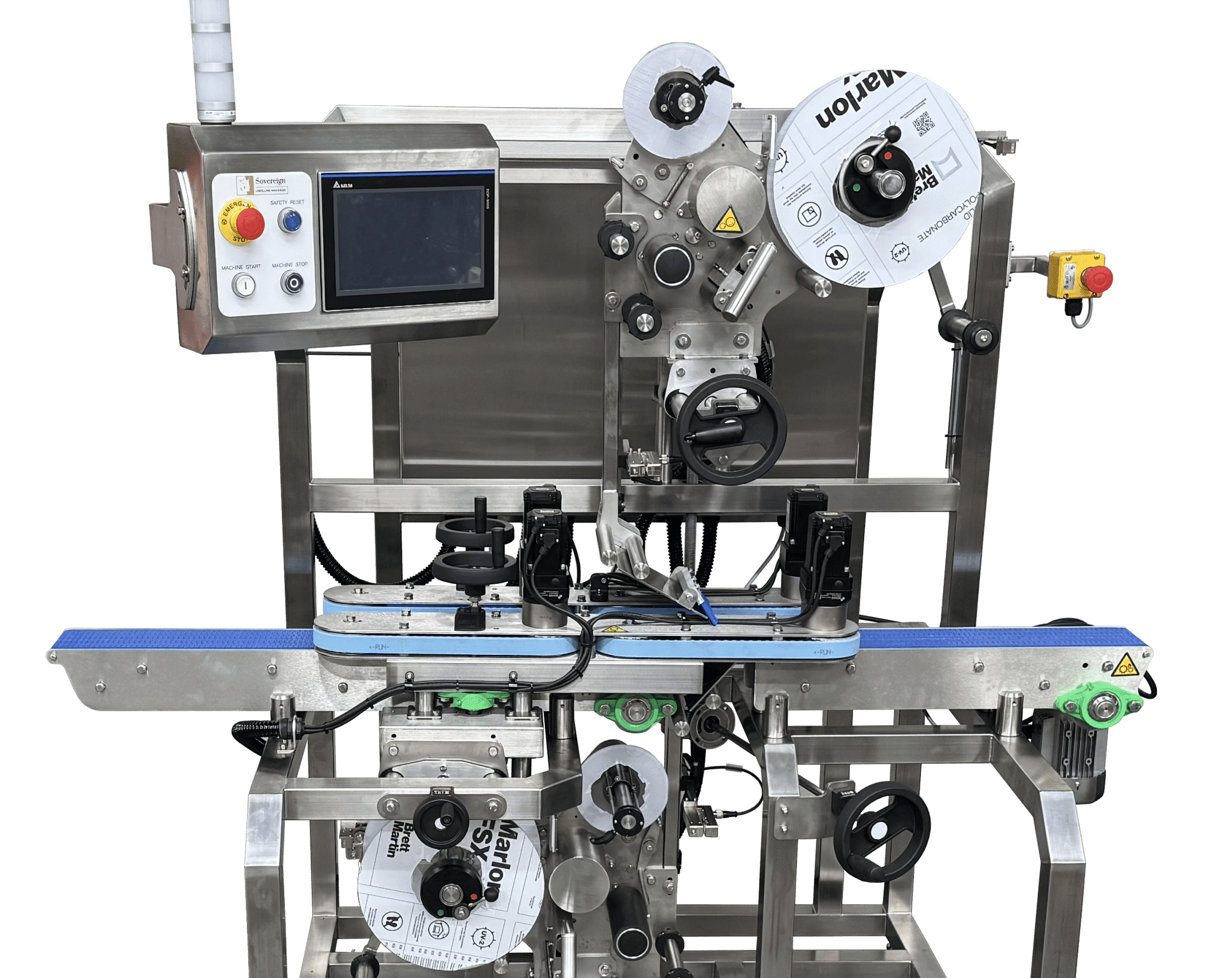
Robust build quality. All of our applicators are mounted on stainless steel frames, which are hygienic, long-lasting & robust.

Flexible, bespoke design capabilities, we don’t build machines to stock but rather design & build machines to suit each customer's requirements i.e. footprint, budget, product type, throughput, etc.

Extremely low cost of ownership, the components we use to build our machines are of the highest standard & quality, therefore offering machines that require very little maintenance spend over its lifetime.

We recommend when you should service your machine, based on running times & usage, we tailor a spares package to suit each individual machine so customers are only buying exactly what we recommend as critical spares.

All machines are PLC controlled, we design each program ourselves, tailored to each machine, with easy to navigate through settings/control via an HMI, which comes standard with each machine.

We are constantly looking at ways to improve the efficiency of our machines, to reduce setup times and make it simple to use for the operators.